

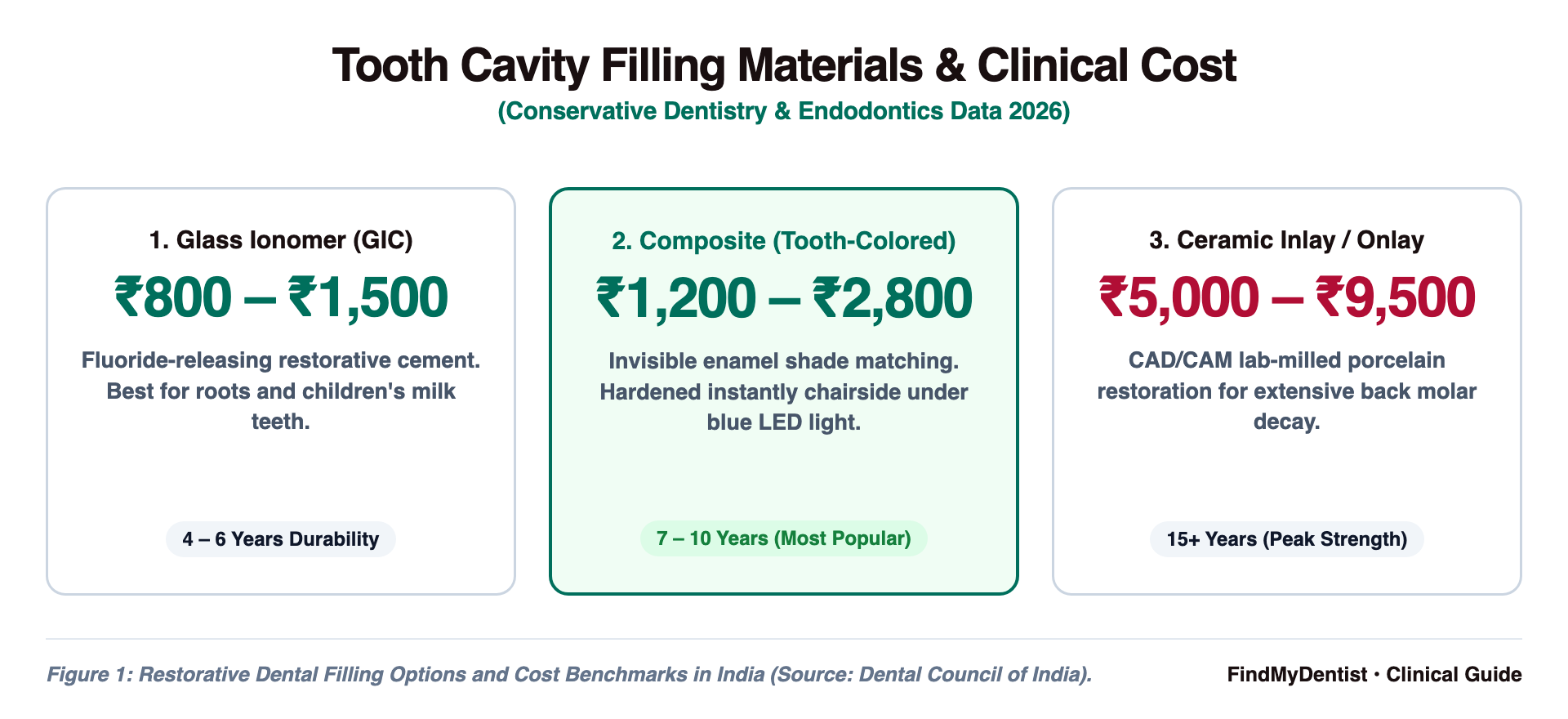
In India, the cost of a dental filling ranges from ₹800 to ₹1,500 for Glass Ionomer Cement (GIC), and from ₹1,200 to ₹3,000 for tooth-colored composite resin fillings per tooth. Deep cavity fillings requiring a calcium hydroxide sedative base or indirect pulp capping cost an additional ₹500 to ₹1,200.
₹1,200 – ₹2,800
₹800 – ₹1,600
₹5,000 – ₹10,000
📍 Don’t Delay: Treat Dental Cavities Early
Catching tooth decay early prevents expensive root canal treatments (RCT) or tooth loss. Book an appointment with verified dentists near you:
1. Dental Filling Price Breakdown by Material
When bacterial plaque breaks down tooth enamel, it creates a cavity (dental caries). If caught before it breaches the inner nerve chamber (pulp), your dentist can remove the decayed tissue and fill the void. The price depends on the material chosen:
| Filling Material | Price per Tooth (₹) | Appearance | Best Clinical Application | Longevity |
|---|---|---|---|---|
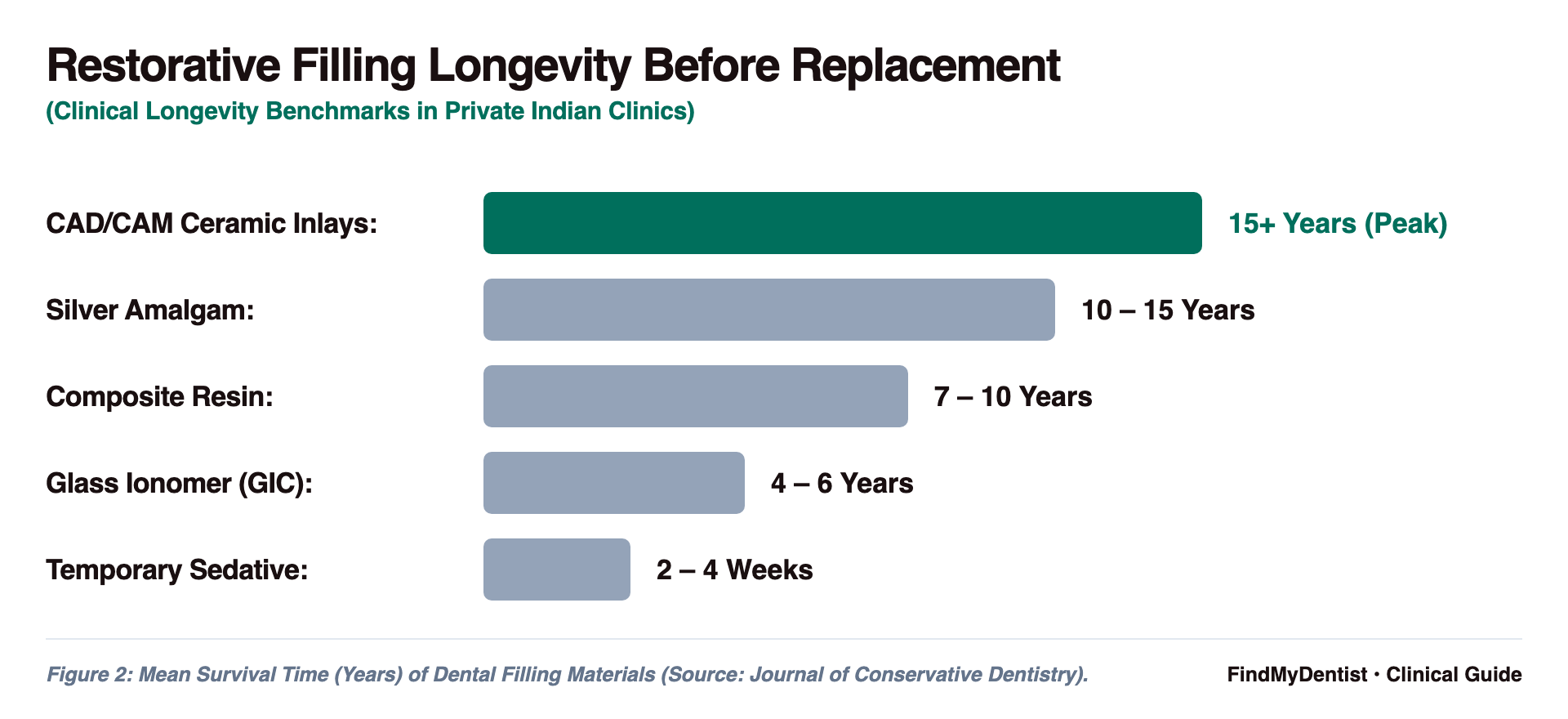
| Tooth-Colored Composite Resin | ₹1,200 – ₹2,800 | Matches natural enamel perfectly | Front teeth, visible smile, small-to-medium molar cavities | 7 – 10 years |
| Glass Ionomer Cement (GIC) | ₹800 – ₹1,500 | Off-white / opaque | Children’s primary teeth, cervical root erosion, sub-gum fillings | 4 – 6 years |
| Silver Amalgam (Traditional) | ₹600 – ₹1,200 | Dark metallic grey | Heavy chewing back molars (declining in modern practice) | 10 – 15+ years |
| Indirect Composite / Ceramic Inlay | ₹5,000 – ₹9,500 | Flawless CAD/CAM ceramic | Severe molar damage where a filling is too weak but a crown is unnecessary | 15+ years |
2. How a Tooth-Colored Composite Filling Is Done (Step-by-Step)
- Anaesthesia & Isolation: If the cavity is deep, mild local anaesthesia is administered. A rubber dam or cotton rolls isolate the tooth from saliva.
- Decay Removal: The infected softened dentin is carefully cleared using a high-speed miniature diamond bur until clean healthy tooth structure is reached.
- Acid Etching & Bonding Primer: A 37% phosphoric acid gel micro-etches the microscopic pores of the enamel. An adhesive bonding agent is brushed on and cured for 20 seconds under a blue LED curing light.
- Incremental Layering: The composite resin is placed in 2mm incremental layers, hand-sculpted to recreate the natural cusps and fissures of your tooth, and hardened with the light wand.
- Occlusion Check & High-Gloss Polish: Articulating paper verifies that your bite is balanced. Fine diamond polishing discs leave the tooth smooth to your tongue.
🦷 Suffering from Food Traps or Mild Sensitivity?
Find verified dentists offering painless tooth fillings and digital X-rays across Maharashtra:
Frequently Asked Questions (FAQs)
Does getting a dental filling hurt?
No. For shallow enamel cavities, dentists often do not even need anaesthesia. For deeper cavities, local numbing gel and an injection ensure the procedure is completely painless.
Can I eat immediately after a composite filling?
Yes. Because composite resin is completely photopolymerized (hardened) by the blue curing light in the clinic, you can chew right away. However, if your mouth was numbed, wait 1 to 2 hours until the numbness wears off to avoid biting your cheek or tongue.
Why is my tooth sensitive after a new filling?
Mild sensitivity to cold drinks or pressure for 3 to 7 days is normal as the dental nerve recovers from preparation trauma. If sensitivity persists beyond 2 weeks or throbs at night, contact your dentist to check if the bite needs minor adjustment.